Who We Are

About

A local concrete contractor serving homeowners across Fresno, CA.

Home › About Us
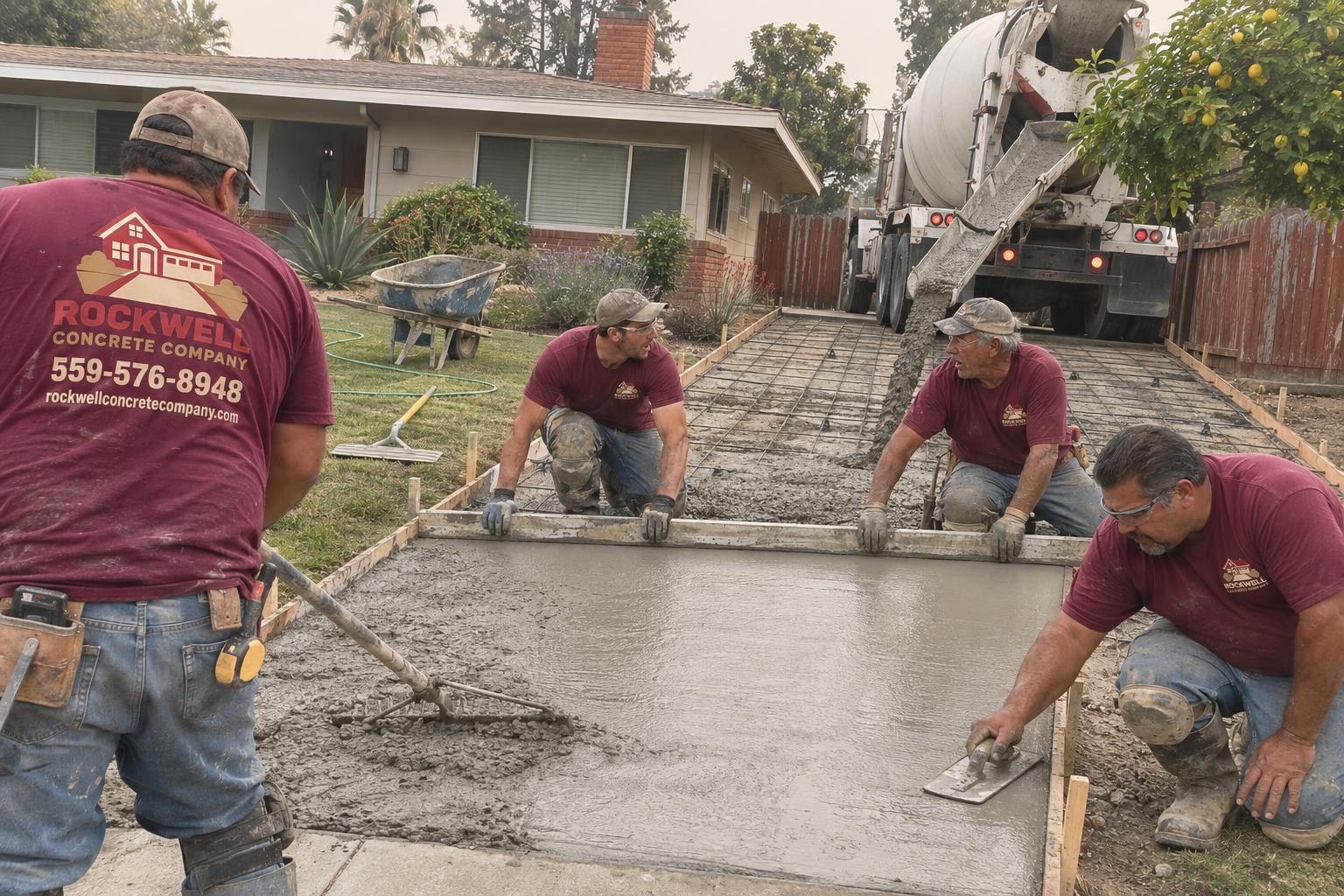
Rockwell Concrete Company crew
Our Story

How we ended up doing this

We pour concrete for a living, driveways and patios mostly, for homeowners around Fresno who are tired of looking at a cracked slab or a driveway that pools water every winter. Most of us came up working for other outfits around the valley before deciding to run our own jobs start to finish. Concrete is unforgiving if you rush it, and that's part of what drew us to it.

If you're on this page, chances are something in your concrete already failed, a slab that sank on one corner, a driveway with a crack running corner to corner, or steps pulling away from the porch. Most of that traces back to the base, poor compaction, no vapor barrier, or tree roots nobody dealt with before the pour. We fix the base first, every time, and only then do we talk finish, because a pretty stamped pattern over a bad base just cracks prettier.

10+
Years Experience
500+
Projects Completed
11
Cities Served
Why Choose Us

What you get when you hire us

None of this is complicated. It is mostly just doing what we said we would do.

Licensed and Insured

If a form blows out or a saw cut goes sideways, you're not the one holding the cost. Ask for our license number and certificate of insurance before you sign anything.

Straightforward Quotes

Our quotes list the PSI of the mix, the thickness of the slab, and whether you're getting rebar or wire mesh. You should know what you're paying for before the truck shows up.

On Schedule

Concrete doesn't wait well once it's batched, so we don't double-book pour days. If the forecast turns, we move the date instead of fighting the mix.

Clean Job Sites

Demo debris, form stakes, and wasted mix all leave the property when we do. You shouldn't be picking rebar scraps out of your lawn a month later.

Our Own Crew

We don't hand the job off to a different crew for the finish work. The person who sets your forms is the person trowelling the surface.

Local Experience

Valley clay expands and contracts hard with the seasons, and our afternoon heat can set a slab before you've finished the finish. We adjust the pour time and the cure method for both.

Common Questions

Things people ask us

Questions about who you'd actually be hiring.

How long has this crew been pouring concrete?
Experience in the concrete trade is usually measured in years spent running forms and finishing slabs, not just years a business has existed on paper. A crew with hands-on pouring experience can explain mix design, control joint spacing, and curing time without hesitation. Asking a contractor to walk through their process for a specific job is a good way to gauge real experience.
Is it an own crew or subcontractors doing the work?
Some concrete contractors run their own crew from forming through finishing, while others subcontract out parts of the job like demolition or decorative finishes. Using one consistent crew generally means fewer communication gaps and more accountability if something about the finish isn't right. It's a fair question to ask directly before signing a quote.
Can past concrete work be seen before hiring?
Reputable concrete contractors can usually show photos of completed driveways, patios, or stamped concrete jobs, and many can point to addresses of past work in the area if asked. Seeing a few projects that are a couple of years old, not just freshly poured, shows how the finish and control joints hold up over time. A contractor hesitant to share any past work is worth a second look.
Why hire a smaller concrete contractor instead of a big company?
A smaller concrete contractor often means the person who quotes the job is also on site for the pour, rather than a sales rep handing the job off to a crew never met before. That usually means fewer miscommunications about finish, color, or scheduling. Larger companies can sometimes offer faster scheduling on bigger commercial jobs, so the right choice depends on the size and type of project.
Where is the crew based and what's the typical coverage area?
Most concrete contractors in the Fresno area are based out of Fresno or Clovis and cover a radius of roughly 50 miles, reaching towns like Visalia, Madera, Hanford, and Sanger. Jobs further out may carry a trip charge to cover travel time and fuel. Confirming coverage for a specific address before scheduling a quote saves time on both ends.
How far in advance does a concrete contractor need to be booked?
Scheduling a concrete contractor often requires a few weeks of lead time, longer during spring and fall when pouring conditions are best and demand is higher. Summer heat in the Central Valley can also push scheduling to early morning pours, which affects how many jobs fit into a week. Booking early is especially important for larger projects like driveways or foundations that need permit approval first.
Will the site get cleaned up after the concrete work is done?
Cleanup after a concrete project should include hauling away old broken concrete, form lumber, stakes, and excess base material, not just sweeping the new slab. Washout from the concrete truck should also be handled away from storm drains and landscaping, since wet concrete runoff can kill grass and clog drainage. Asking what's included in cleanup before the job starts avoids confusion afterward.
What happens if something gets damaged during the concrete work?
A licensed and insured concrete contractor carries liability coverage for damage to sprinkler lines, fences, utilities, or landscaping that happens during demolition or pouring. Any damage should be documented and addressed as part of the original agreement rather than treated as a surprise cost to the homeowner. Confirming insurance coverage before work starts is worth the extra five minutes.
Will a job get finished that another contractor started or abandoned?
Picking up a partially completed concrete job depends on what stage it's in, forms already set and base prepped is easier to take over than a slab that's partially poured or already cracking. The new contractor usually needs to inspect the existing work, including the base compaction and any rebar already placed, before giving a quote to finish it. Some situations call for tearing out what's there rather than building on a foundation of unknown quality.
How can concrete work be checked for quality while it's happening?
A few visible signs separate a careful concrete pour from a rushed one: the base gets compacted and leveled before forms go up, rebar sits elevated on chairs rather than resting on the dirt, and control joints get cut the same day as the pour rather than days later. Asking the crew what PSI mix is being used and when the joints will be cut is a reasonable question on any job site. A contractor willing to explain each step as it happens is usually one who knows what they're doing.

Got something that needs doing?

Free estimate, a price in writing, and work we stand behind.
Call (559) 576-8948